Growth Factors
GHK-Cu
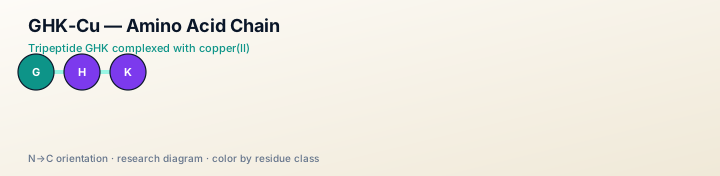
Copper Tripeptide (Gly-His-Lys·Cu²⁺)
Scientific Overview
GHK-Cu is a naturally occurring copper-binding tripeptide studied for extracellular-matrix remodeling, antioxidant gene programs, and skin/wound biology.
Mechanism focus: GHK chelates Cu²⁺ and is reported to modulate metalloproteinases, collagen/elastin-related gene expression, and anti-inflammatory transcriptional programs in skin and soft tissue models.
Research Use Cases
- Dermal regeneration and cosmetic-peptide research
- Wound-healing and scar-remodeling assays
- Hair follicle and scalp biology models
- Gene-expression studies of copper-peptide signaling
Use-Case Study Notations
- Case-study notation: Pickart and colleagues documented GHK-associated tissue remodeling and gene resetting signatures in skin-aging contexts.
- Case-study notation: copper-tripeptide complexes have been evaluated for attenuating inflammatory and fibrotic responses in lung injury models.
- Formulation stability of the Cu²⁺ complex is an important analytical QC variable.
Selected Studies (English, PubMed)
Five peer-reviewed sources indexed on PubMed. Links open the PubMed record for verification.
- The human tri-peptide GHK and tissue remodeling — PubMed 18644225
- GHK and DNA: resetting the human genome to health — PubMed 25302294
- The potential of GHK as an anti-aging peptide — PubMed 35083444
- GHK Peptide as a Natural Modulator of Multiple Cellular Pathways in Skin Regeneration — PubMed 26236730
- The glycyl-l-histidyl-l-lysine-Cu2+ tripeptide complex attenuates lung inflammation and fibrosis — PubMed 38879894
Related compounds
Research Use Only. This page is educational and intended for laboratory research context. Products are not for human consumption and are not intended to diagnose, treat, cure, or prevent any disease.