Cognitive
Dihexa
Angiotensin IV–Derived Peptide
Scientific Overview
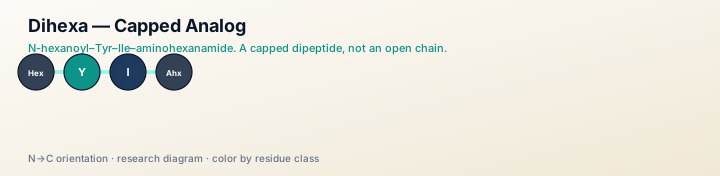
Dihexa is a peptide analog developed from angiotensin IV research. Laboratory literature examines its relationship to hepatocyte growth factor (HGF) and the c-Met receptor in synaptic models.
Mechanism focus: Preclinical papers report that procognitive and synaptogenic effects of angiotensin IV–derived peptides, including dihexa, depend on HGF/c-Met signaling rather than classical angiotensin-receptor blockade.
Research Use Cases
- HGF/c-Met signaling assays
- Synaptogenesis models
- Cognitive-research pathway studies in laboratory animals
- Comparison with other angiotensin IV–related peptides
Use-Case Study Notations
- Case-study notation (preclinical): HGF/c-Met dependence has been reported for synaptogenic effects of angiotensin IV–derived peptides.
- Case-study notation (preclinical): later animal papers examine dihexa in cognitive-impairment and nerve-repair models.
- Independent human interventional evidence remains limited compared with the preclinical literature.
Selected Studies (English, PubMed)
Three peer-reviewed sources indexed on PubMed. Links open the PubMed record for verification.
- The procognitive and synaptogenic effects of angiotensin IV-derived peptides are dependent on activation of the hepatocyte growth factor/c-met system — PubMed 25187433
- AngIV-Analog Dihexa Rescues Cognitive Impairment and Recovers Memory in the APP/PS1 Mouse via the PI3K/AKT Signaling Pathway — PubMed 34827486
- Stem cell, Granulocyte-Colony Stimulating Factor and/or Dihexa to promote limb function recovery in a rat sciatic nerve damage-repair model: Experimental animal studies — PubMed 34703584
Related compounds
Research Use Only. This page is educational and intended for laboratory research context. Products are not for human consumption and are not intended to diagnose, treat, cure, or prevent any disease.