Growth Factors
IGF-LR3
Long Arg3 IGF-I Analog
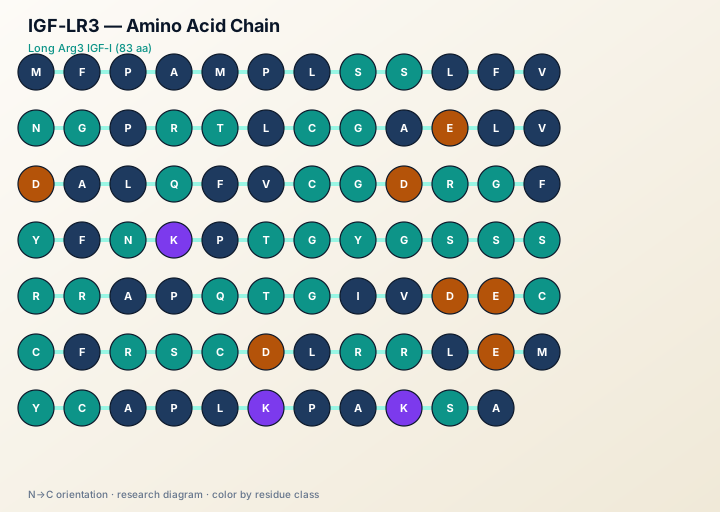
Scientific Overview
IGF-LR3 (Long Arg3 IGF-I) is a modified insulin-like growth factor-I analog. An arginine substitution and an N-terminal extension are studied because they reduce binding to IGF-binding proteins relative to native IGF-I.
Mechanism focus: Research compares IGF-I receptor engagement and binding-protein interaction of LR3-IGF-I with native IGF-I in biochemical and animal models. It is a growth-factor analog, not a GHRH peptide.
Research Use Cases
- IGF-I receptor pharmacology
- IGF-binding protein interaction assays
- Comparative growth-factor analog studies
- Analytical identification of LR3-IGF-I reference materials
Use-Case Study Notations
- Case-study notation: animal studies have used Long-R3-IGF-I as a probe of the somatotropic axis.
- Case-study notation: expression and physicochemical papers describe production and properties of LR3-IGF-I protein.
- Results in one model should not be generalized. This page does not present clinical outcome claims.
Selected Studies (English, PubMed)
Five peer-reviewed sources indexed on PubMed. Links open the PubMed record for verification.
- The somatotropic axis in neonatal calves can be modulated by nutrition, growth hormone, and Long-R3-IGF-I — PubMed 9252489
- Physicochemical characteristics of LR3-IGF1 protein inclusion bodies: electrophoretic mobility studies — PubMed 11485445
- Recombinant expression of IGF-1 and LR3 IGF-1 fused with xylanase in Pichia pastoris — PubMed 37261455
- IGF-1 LR3 does not promote growth in late-gestation growth-restricted fetal sheep — PubMed 39679943
- Attenuated glucose-stimulated insulin secretion during an acute IGF-1 LR3 infusion into fetal sheep does not persist in isolated islets — PubMed 37114757
Related compounds
Research Use Only. This page is educational and intended for laboratory research context. Products are not for human consumption and are not intended to diagnose, treat, cure, or prevent any disease.