Stacks
CJC/Ipamorelin
CJC + Ipamorelin
Scientific Overview
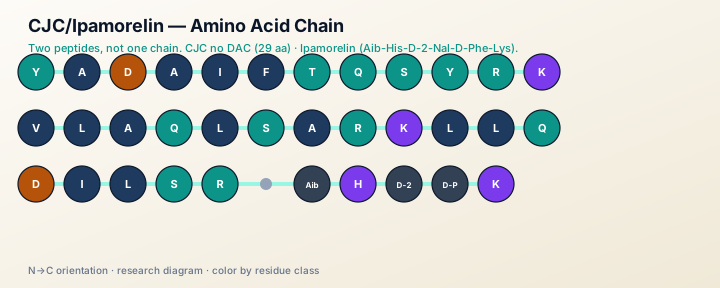
CJC/Ipamorelin is a two-peptide research stack: the short-acting CJC GHRH analog (not CJC-1295 with Drug Affinity Complex) plus ipamorelin, a selective growth-hormone secretagogue. Each component has its own literature. This page does not claim a single pivotal trial of the fixed combination.
Mechanism focus: CJC-class peptides are studied at the GHRH receptor. Ipamorelin is studied as a ghrelin-receptor agonist with selective GH release in preclinical work. Combination use is a research design that engages both pathways.
Research Use Cases
- Combined GHRH-receptor and ghrelin-receptor models
- Growth-hormone axis co-stimulation studies
- Comparison with either component alone
- Identity testing of two-peptide preparations
Use-Case Study Notations
- Case-study notation: ipamorelin papers describe a selective growth-hormone secretagogue, separate from GHRH analogs.
- Case-study notation: CJC-1295 pharmacokinetic trials describe the DAC analog and are not studies of this stack.
- Read the CJC and Ipamorelin pages for the single-compound identities.
Selected Studies (English, PubMed)
Five peer-reviewed sources indexed on PubMed for the component peptides and for GHRH-analog research. This page does not claim a pivotal trial of the fixed combination. Links open the PubMed record for verification.
- Ipamorelin, the first selective growth hormone secretagogue — PubMed 9849822
- Ipamorelin, a new growth-hormone-releasing peptide, induces longitudinal bone growth in rats — PubMed 10373343
- A new series of highly potent growth hormone-releasing peptides derived from ipamorelin — PubMed 9733495
- Advances in the detection of growth hormone releasing hormone synthetic analogs — PubMed 34665524
- The emerging landscape of performance-enhancing peptides modulating GH-IGF1 axis: bridging the gap between clinical evidence and patient self-administration — PubMed 42395176
Related compounds
Research Use Only. This page is educational and intended for laboratory research context. Products are not for human consumption and are not intended to diagnose, treat, cure, or prevent any disease.